Darkness and Sight

So, after receiving the morsel of bread, he (Judas) immediately went out. And it was night.” John 13:30

Now on the first day of the week Mary Magdelene came to the tomb early, while it was still dark” John 20:1

In John’s narrative, between John 13:30, when Judas departed to betray Jesus, and John 20:1 on what we now call Easter morning, it had been a long dark night.

Of course, the sun rose on Friday morning after Judas’ betrayal of Jesus and it rose again on Saturday morning. But spiritually speaking, it was as dark as dark could be. It was a long night.

John is a brilliant writer, nothing in his gospel is of insignificance. Note for example that the Bread of Life was offering Life to Judas, but Judas only partook of a “small morsel of bread and he immediately went out.” Judas did not partake fully of Jesus and then left his company. John’s observations are astute.

For John, Maundy Thursday night to Easter morning was one long night. It was a very dark time.

Our Darkness

There are periods in our life when life is dark. The sun rises, but it’s light does not seem to penetrate our night. St. John of the Cross’ description of “the dark night of the soul” is an apt description. Whether you agree theologically with St. John of the Cross or not, we all go through dark times in life.

Some of us find ourselves living in dark environs. Spiritual forces of darkness have existed uncontested for extensive periods of time. Small lights begin to pierce that darkness as a church gathers, yet the darkness will push back.

What darkness do you find yourself in? Does your night have a name?

Night Vision

John does not mention any light in the remainder of chapter 20. But the words “saw” and “seen” is circled 13 times in my ESV Bible. It may have been dark, but a new sight is being IMG_3715granted to those who believe.

Jesus and Thomas have their famous post-resurrection interaction. Jesus makes this most encouraging comment: “Have you believed because you have seen me? Blessed are those who have not seen and yet have believed (John 20:29 ESV).”

Thomas would not believe until he saw Jesus for himself. However, John is writing his gospel narrative decades later to people who have not had that privileged opportunity to physically see the resurrected Jesus. So John makes it clear that it is possible to believe without a physical sighting of Jesus. Indeed, Jesus pronounces a special blessing on those of us who have yet to seen him yet believe.

In your night, do you believe him? Faith grants us a sight that no darkness can blind.

Peter in his first letter, writing to a deeply persecuted church, recalled Jesus’ words when he wrote:

Though you have not seen him, you love him; and even though you do not see him now, you believe in him and are filled with an inexpressible and glorious joy, for you are receiving the end result of your faith, the salvation of your souls (1 Peter 1:8-9 NIV).”

Job, thousands of years before there was the dark night of our Savior’s death made this bold faith statement:

“I know that my redeemer lives, and that in the end he will stand on the earth. And after my skin has been destroyed, yet in my flesh I will see God; I myself will see him with my own eyes—I, and not another. How my heart yearns within me! (Job 19:25-27 NIV).”

Your Sight in Darkness

May God grant you eyes in the darkness of any spiritual night you find yourself in.

May you in his grace partake of the Bread of Life and not merely a small morsel.

May he grant you a growing yearning to see him one day.

Jesus conquered death, he can conquer anything you are facing today. He is Risen.

Posted in Shepherding Well | 1 Comment

Calling, Purpose and Ministry Fit for Retention

Improper Ministry Fit can be a Death Sentence to Workers
One of the core elements of resiliency is a sense of purpose.

This is fulfilled by being graced with responsibilities and commensurate authority to fulfill those responsibilities that match ones spiritual gifts, skills, personality and sense of what God has asked one to gives one’s life to as closely as is possible.

That’s a long sentence. Let’s break it down.

Responsibilities and Authority
If someone is given a job, then let them do the job. That means make decisions, spend money and manage details without having to ask for permission constantly. Of course, there are organizational restrictions such as values, missional objectives, budgets, procedures, protocol and policies. Get staff up to speed on all that, provide supervision and feedback, but then set them loose to go do the job. Sure they’ll make mistakes. That is how we all learn and grow.

Responsibilities that Match Gifting, Skills and Personality 
Too often organizations have a bunch of proverbial round holes to fill and square pegs are squashed into them so the holes are filled.

The classic scenario is field leadership. All of us have seen again and again some poor person made the field leader simply because they have tenure. Whether they are gifted as a leader, have leadership skills and the right personality to navigate the complexities of leadership don’t seem to be considered. The hole has to be plugged, so plug it. I cannot count the number of field leaders I have spoken to over the years who have expressed exasperation at being put in that role. This is a set up for failure.

The objective is to place people in roles that they are gifted, trained and passionate about. That sense of purpose fulfillment will carry folks through a great deal of struggles along the way.

That Vague Thing of Calling
Calling is that sense of what God has clearly told you, with other’s affirmation and guidance, to give your life to. Its that work that if you do not do, you will feel like you are not living life as you should. Of necessity you have to do it. It may be for a stage of life, but it is real in that time period.  If we do not do what God has asked us to give our lives to, the inner dissonance will take its toll.

Not a Perfect World, But…
Yes, it is easy to speak in terms of ideals. There are times we all have to do some work that is outside our sweet spot. However, that cannot go on for long. It must be stop gap at best or the data shows people will seek a better fit elsewhere. Like leave the field….


What if You Feel Misfit?
It behooves us to be excellent students of ourselves. Take those assessments even if you don’t like them. StrengthFinders is great place to start. A trained StrengthFinders coach can be a coup of insight into where you will be most fruitful.

Can you articulate clearly what God has asked you to do? Write it down. Pray over it. Let it sit for a while. Come back to it and if it burns in you, then who can you talk to about that?

What other suggestions for role fit do you have?

Posted in Shepherding Well | 5 Comments

Relationships Essential to Resiliency

A dear friend, with whom I graduated college, and her husband are some of the most amazing Christ-winners in the hard, spiritual soil called Japan that I know.

She did her doctoral dissertation on what the thematic elements are that are make or break for people to last long-term in Japan or attrit after a few years.  One of her findings was that we need connection with other people who are in the same predicament we find ourselves in.

Its the whole “we are in the same boat together” idea.

Community Essential to Resiliency
The early years of cross-cultural work bring similar predicaments the world over: language proficiency, enculturalization, learning to live amongst spiritual oppression, ministry discovery and placement. Many places add the dynamics of security concerns.

What my friend found is that if the workers who are in this early stage of acclimating to the field find each other and stick together, they have a higher chance of thriving.

We need others to laugh and cry with who “get” our life.

Relational or Mentoring Constellation
Dr. Robert Clinton came up with the concept (I believe) of a “Mentoring Constellation.” The idea is we need a constellation of relationships in our lives.

The attached .pdf can be downloaded and used for you to ponder who you have in your life.

Mentoring Constellation worksheet

Here is an explanation of each “category” of relationships:

Mentors – we all need people who pour into our lives. These relationships can be formal such as a professor, counselor or spiritual director, or less formal such as an older person you spend time with.

Peers Inside Our Organization – these are colleagues in our organization. As peers we journey together toward missional objectives as well as tending to one another.

Peers Outside Our Organization – these are peers who are not part of our immediate context. These relations are important because they bring fresh objectivity into our world. And they can be a safe place to appropriately process dynamics in our present circumstances.

My wife and I are part of a small circle of three couples who talk regularly by video call. We live in different countries. We are a safe place to openly share life and hear one another’s perspective.  We also have a small circle of peers who live in our area. I cannot imagine not having these and other safe places to talk.

Mentorees – these are people we make ourself available to. A key element of finishing well is that we develop others, not as the local “guru,” but as available, experienced journey mates.

Design and Pray for Your Community toward Resiliency
Who do you have in each of these areas of your life? Where can you find them? Others need you too, so pursue others to be available for them.

Be relentless in pursuing these relations as we all need them to be resilient and healthy in this journey. Ask God to provide key, mutually beneficial relationships in your life.

Posted in Shepherding Well | 1 Comment

Why You Need a Clear Job Description

Four Essentials for a Staff Person’s Success
There are four essential elements for a staff person’s success:

  • A clearly defined role (job description)
  • Regular feedback (annual review)
  • Missional clarity (what the individual or team is to be about)
  • Executive empowerment (delegated authority to fulfill one’s role)

Have you received all four of these?

Let’s look at just one area, the job description.

What’s in a Job Description?
A job description provides a very clear set of expectations.Screen Shot 2017-03-28 at 3.46.50 PM

So many global workers I engage have ill defined roles. Further, those roles are usually multiple. In the end the person is frustrated (as well as exhausted) as none of the roles are fulfilled well.

Ministry misfit is too common a dynamic in cross-cultural work. This reality is but one cause of attrition.

A clearly defined role and responsibility is an essential element for healthy workers and effective work. To not take the time to develop accurate roles can lead to loss of personnel at worst and ineffective work in the least. This is avoidable attrition.

Potential Impact of Ill-Defined Roles
Directionless.  We all need clear direction. Identifying expectations can be clearer direction.  A job description is the first step toward addressing these areas.

Misfit. Too many workers are placed in  roles that they are not gifted or skilled for. A wiser course is to explore their gifts, skills, personality, and sense of dreams and calling with them. The solution could be as easy as a merely a lateral move to a better fit for them. It is better to not fill a role and have a worker placed in an area of effectiveness than cram that person in the wrong role. Otherwise, the job might not be done well and you could lose the worker in the long haul.

Overload. Way too many of us carry multiple roles that present an unrealistic level of work. Exhaustion and ineffectiveness can be the result. We want to make sure the expectations are realistic. Overreach is not effectiveness.

What Can You Do?
If you are interacting with a worker who expresses lack of direction, feeling misfit for the role, or otherwise overwhelmed with the sheer amount of work before them, you can ask them about a clearly defined job description. If this is not a common practice in their role, help them write on out to be submitted to a supervisor.

How about you, shepherd?
What is your job description? Is it clearly defined? Are you given permission to focus in your areas of gifting and skill sets? Who can help you write a clear, concise, well thought out job description?

Anyone seen  brilliant member care job description they would be willing to share? We all need good models. Thanks!

Posted in Shepherding Well | Tagged , , | Leave a comment

Theme #5: Lack of Permission for Personal Development and Care

(This is one of a five part series on responding to thematic issues affecting member care providers and cross-cultural worker’s health and effectiveness. You can read the intro.)

Some Assumptions
I bring into this topic an assumption. That assumption is that God’s redemptive process never ceases.

As I use the phrase “personal development and care,” I am using it as an expression of intentionally leaning into the reality of God’s ongoing redemption.

God seeks to  draw us ever deeper into his love. As we grow deeper in that communion, we become like the One we are communing with. Transformation takes place. From that transformation the possibility of greater missional fruitfulness can happen as well.

We are whole beings and seek integration. Thus, we seek to be intentional about growth emotionally, relationally, spiritually, and professionally.

With these assumptions in hand, it is imperative that we are ever responsive to God’s ongoing redemptive activity. A key way of doing that is to intentionally design ways and means that facilitate growth. That requires time, money, energy…..and that is where the rub is.

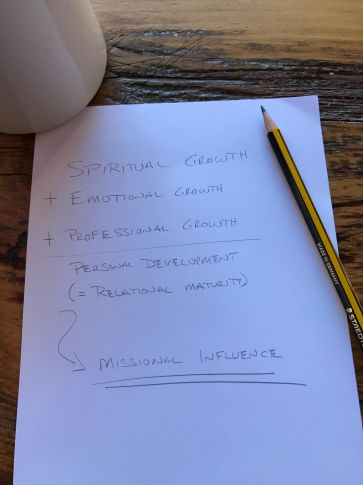
Simple Mathunnamed
My math works like this:

Spiritual growth + emotional growth + professional growth = personal development = relational maturity* (with God  and others) —> which makes for the possibility of greater missional influence.

*(Maturity is always exposed in the context of relationship. In other words, as we grow our capacity to receive and convey love increases.)

IF this is good math, then personal development is an essential ingredient of missional accomplishment. That requires time, money, focus, and permission. Permission is self-granted and it is organizationally granted.

Organizational DNA
There are too few organizations which have personal development as part of their cultural DNA.

Some essential ingredients of that DNA would be budgeting of time and money for personnel’s ongoing development.

There is a relational side to this too. Part of normal conversations would be people being asked when and how they are staying personally vibrant and maturing as well as professionally equipped.

Of course, leadership is has an essential role. Leaders can model ongoing personal development. They aren’t merely telling us to do this. They do it themselves and share stories of their own growth. This grants permission and vision for a path forward.

Taking Personal Responsibility
No matter what organizational culture I find myself in, the onus is still on me. I alone am responsible for how I steward God’s constant invitation toward himself. I can budget money and time to attend conferences and schedule personal retreat.

How Do You Grow?
God has taught me about myself. Here is some of what I need to be growing: books to learn; space and time to reflect, think and create; others to pass ideas by to make sure I am on track and receive counsel from; a monthly day of prayer; external input from learning opportunities; time to play outside….

  • How do you learn?
  • What do you need?
  • Who could mentor you?
  • How will you schedule and budget for that?

Will their be hinderance? Yes! Mom’s of little ones could wonder how this could ever happen. Living in a major urban environment can make it hard to find space and quiet. Limiting budgets can feel restrictive. But, if God is as committed to this as I am suggesting, then I believe he will provide. Ask your Father to do so.

As shepherds of others, it behooves us to always be growing and seek personal vitality. We can only lead others to where we have gone ourselves.

Posted in Living Wisely, Personal Vitality, Shepherding Well, Spiritual Vitality, The Shepherd's Health, Thinking Well | Tagged , , , , , , , , , , , | 5 Comments

Resource: A Family Debriefing Option

Here is another debriefing option for yourself, your family or others you know. Contact information is at bottom.


interlude

Interlude – A Debriefing Retreat for Global Workers

Upcoming Dates and Locations

June 13 – 16, 2017 – Noblesville, Indiana USA (Singles and Couples)
July 31 – Aug 3, 2017 – Littleton, Colorado USA (Now available for families as well as singles and couples)
January 2 – 5, 2018 – Littleton, Colorado USA

When a person tells his story and is truly heard and understood, he undergoes actual changes in his brain circuitry that corresponds to a greater sense of emotional and relational connection, decreased anxiety, and greater awareness of and compassion for others’ suffering.

—Curt Thompson, M.D., Anatomy of the Soul

Join us for a four-day debriefing retreat designed especially for global servants engaged in cross-cultural ministry. Interlude is a time to reflect, process, and tell your story to experienced, trained debriefers as well as a small group of your peers.

What will you do at this retreat?

  • Reflect on relevant life questions in a safe environment
  • Share and process your story with experienced, trained debriefers
  • Participate in debriefing activities with a small group of peers
  • Integrate past challenges and successes into your life story
  • Begin to look toward the next step of your journey

In the mornings, you will participate in a time of worship and a brief devotion related to topics such as Jesus as the master debriefer, surrender and forgiveness, grief and loss, and change. These will be followed by individual and small group activities designed to facilitate the telling of your story.

In the afternoons there will be opportunity for individuals and couples to tell their story to Barnabas staff members who are trained and experienced in helping you process and integrate your ministry story.

At the Colorado Interlude, children (6 years +) will be debriefed in a separate program following the same themes as their parents using hands-on, fun, group and individual exercises. At the end of the 4 day session, a special Family Bonus Day will be provided in which families will come together to be debriefed as a family unit.

Cost and Fees

Indiana Interlude (June 13 – 16) cost: $250 per person or $480 per couple (includes lunch, snacks, and materials). Price does not include accommodation or transportation, which you will need to arrange for separately. Some housing may be available with host families.

The Colorado Interlude (July 31 – Aug 3) (Family Bonus Day Aug. 4) $250 per person or $480 per couple (includes lunch, snacks, and materials). Price does not include accommodation or transportation, which you will need to arrange for separately. (Some housing may be available with host families on a first come basis)

The Colorado Interlude will include a debriefing program for children ( 6yrs. +) following the same themes as the adults. Cost is $250 per child. This price includes lunch, snacks, and materials.

Family Bonus Day – (Friday, August 4) Families, who attend the Colorado Interlude, will receive a special bonus day of debriefing for family units at no additional cost.

Register Now

 Click Here to register on the Barnabas International Website

 For more information contact:

Terry Todd

ttodd@barnabas.org

1-720-421-4154

Posted in Shepherding Well | Leave a comment

Theme #4: Identity Attached to Role and Performance

(This is one of a five part series on responding to thematic issues affecting member care providers and cross-cultural worker’s health and effectiveness. You can read the intro.)

My False Identity Revealed to Me
A little over 10 years ago I was recovering from a nasty bout of hemorrhagic dengue fever. Up until then my medical history was, in a word, boring. That all changed with this tropical fever. Even months later, I was recovering very slowly . Eventually, I had to make the hard call of canceling a commitment that I really, really wanted to fulfill.  After I finally made myself make the call, I literally fell to my knees and out from my mouth blurted the words, “Lord, I don’t even know who I am anymore!”

Every now and then something comes out of mouth that stops me in my tracks. In those moments I know I’ve just been given a glimpse into my inner reality. Jesus said that what comes out of our mouths reveals our hearts (see Matthew chapters 12 and 15). My heart had just been revealed to me by my own mouth.

With ministry roles stripped away, I was wrestling with my identity. This was a legit identity crisis. For my identity was misplaced and God was kindly, if not tumultuously, revealing that to me.

Common Ground
Morris Dirks writes, “Often, the at-risk nature of ministry is increased by the leader’s failure to develop a strong sense of self in his or her early years. I have observed that a particularly high number of people who enter the ministry remain oblivious to unresolved issues surrounding their identity— issues that frequently are connected to their family of origin….One of the ways our false self tries to compensate is to find our identity in performance. Hence, the motives driving the ministry are tainted…..”*

God has created each of us with an innate need to have an identity. However, in our brokenness we seek our identity in many wrong places.

“One of the ways our false self tries to compensate is to find our identity in performance.” We all do this. How aware are you of your performance-based compensations?

Jesus Knew the Source of His Identity
God addressed identity with Jesus at various times in his earthly life such as at his baptism and his transfiguration on the mountain. The Father’s voice would thunder declaring that Jesus is his “beloved Son with whom he is well pleased.” It is interesting that Jesus doesn’t flinch at these words. He knows them well. He knows he is the beloved Son of the Father. He did not scramble for a sense of identity and thus he was free to offer his life to others.

Do you know that you are a beloved son or daughter of the Father?

This is Mission Critical
To the degree our identity is misplaced is to the degree we will hurt others relationally even as we go about missional work. This begins with our relationship with God and oozes in every direction.

Our unhealthy ways of relating can be overt or exceptionally subtle. What’s more, they are likely a blind spot. For those of us in the care giving vocation, we are on dangerous ground. If we need to be needed and are blind to that, then the very care we offer to others is ultimately for our own end. That is manipulative. It is also, sadly, exceptionally common.

Identity Healing
It behooves all of us to lean into God regarding this area of our redemption. A lack of maturity is undermining our ability to love and serve others.

What are some indicators  we are growing in our identity?

  • Others’ opinions have less importance to us.
  • We learn to seek affirmation, approval or value from what we do less and less.
  • We do not turn conversations onto ourselves, rather focus on others.
  • When appropriate, we can say no to another’s request without creating waves of internal distress within us.
  • We willingly live within our own limitations and capacities.
  • Fear is decreasingly a driving force within.
  • We increasingly become comfortable in our own skin.
  • Our resistance to God’s and others’ love lessens. We drop our guard and receive.


God is constantly offering healing and orientation in this area of our lives.

How do you deflect or otherwise block God’s love and affirmation?

How is God seeking to heal unhealthy identity sources in your life?

If it is true that we all have blind spots in our emotional world, who do you rely upon for objective counsel?

As always, any comments are helpful for all reading. If you find this helpful, please feel free to forward it to others. Thank you!

*Dirks, Morris in Forming The Leader’s Soul: An Invitation To Spiritual Direction

Posted in Shepherding Well | Leave a comment

Theme #3: Relationships in Crisis

(This is one of a five part series on responding to thematic issues affecting member care providers and cross-cultural worker’s health and effectiveness. You can read the intro.)

Can You Relate?
A couple was conveying their deep sense of being stuck in their career due, in part, to not knowing how to navigate an under-current of “not being on the same page” with their present supervisor. This had been going on for over 10 years. A decade of frustrating disconnect which had resulted in aspects of being misfit in their responsibilities, feeling under-appreciated for their efforts, and generally losing trust with current leadership. The level of discouragement was immense.  One could understand why.  And, I am sure if I was sitting down with that leader in question he or she would convey their own version of heartache as well. How do we get so stuck relationally?

WARNING LABEL: I am going to be direct on this subject, for it is killing us….

Though I should know better, I am still stunned at the level of unresolved conflict out unnamed-1there. I am perpetually taken aback at the amount of triangulation, talking poorly of others absent from the room, and general immature ways we relate when we are not seeing eye-to-eye.

Frankly, when it comes to interpersonal conflict, we are way too emotionally immature.


We are Nice but not Loving
I think it is pastor and author John Ortberg who wrote that “we nice each other to death” in the church and our mission organizations.

When I am with a group of people talking about the topic of stress – of which interpersonal conflict is a major cause – I will bring up the dynamic of passive-aggressive ways we relate. We send out non-verbal messages; we talk about others; everyone in the room knows we are unhappy about something, but the truth is hardly ever openly addressed. We are masters of passive-aggressiveness. This ranges someplace between a stunning blindspot to outright deliberate unwillingness to being loving toward others.

When asked why, common responses I hear are, “I don’t want to hurt their feelings” or, “I don’t want them to feel bad” or, “I hate conflict.”

We’ve convinced ourselves we are being nice but in reality we are profoundly self-preserving.

In the end, conflict avoidance simply comes down to self-preservation. It scares us. So we harm others with the way we passively relate rather than have the courage to lean into the other person in a direct, tactful, timely, and loving manner to share our hearts.

When I willingly put myself in potential harm’s way (like being uncomfortable with a conversation), then I am beginning to love the other. Yes, this might backfire, but I am willing to do what is right regardless of personal cost. 

I sense that the majority of us would simply be flummoxed in even knowing how to begin such a conversation. There is so little healthy modeling of this it has become a foreign manner of relating.

Throwing Stones is Easy
It is easy to identify the problem. Offering a solution is much harder. So, what is the way forward in emotional and relational maturity? How does one become an emotional adult in the area of relational conflict?

First, if anything you’ve read here rings true in your own heart, the place to begin is simple, raw, unedited confession and repentance. Talk to God first.

Then, begin to ask God to show you all of your fear and poor, life-long habits of relating when it comes to conflict.

img_7919

There is Beauty Amidst all those Prickles

Scary stuff, I know.

Someplace in here, maybe with the help of counsel, we may have to go to those we have held ill-will towards, confess that, and ask for forgiveness. This can be super scary. It is the key step toward taking responsibility for our own actions.

There are times when trust has broken down so much that the need for a third party mediator is required. Pursuing this is wise and courageous, though never easy.

Beyond that, we can take other practical growth steps.

If you know someone who does conflict well, ask them to teach you.

There are some great trainings out there, like SYIS.

Peter Scazzero has some wonderful resources published. I strongly recommend anyone with a pulse to read his Emotionally Healthy Spirituality book.  You can take a free online  emotional health assessment here.  You can also print a hard copy of this assessment and take it as a team. If you are honest in the assessment, it can be a bit sobering how many areas of one’s life fall in the emotional adolescent category. This assessment can provide some concrete areas to lean into in your path of maturation. Take special note of Scazzero’s description of an emotional adult on the final page of the assessment. I’d change a few words here and there but it is one of the best measuring bars I have seen in print. Pray over each descriptor. How will you grow in each?

We all need places to process when we feel stuck in relationships. Debriefers, counselors, spiritual directors and other advisors can help us to begin to get “unstuck” relationally.

Bottom Line: I am responsible for myself in all my relationships.

The infected wounds of unresolved conflict is literally undermining the work of the gospel in the very places where people are desperate to witness the reality of the living, forgiving Lord through his people. For the sake of the gospel, your own soul, and others whom God loves too, I pray you lean into all those mucky relationships you have in your journey.

Does anyone have other helpful resources in this category?

(Thanks for grace as I speak frankly on the subject. If I have offended anyone, please let me know so I can apologize!)


Posted in Shepherding Well | 5 Comments